
Bldc Motors An Overview
Published:
Brushless DC (BLDC) motors have quietly become one of the most widespread motor technologies in modern engineering. From the cooling fan inside your laptop to the traction motor in an electric vehicle, they appear everywhere — yet the principles behind them are rarely explained in a concise, end-to-end way. This post walks through what a BLDC motor is, why it was developed, how commutation actually works, how it is driven, where it is used, and the hardware components that make up a complete system.
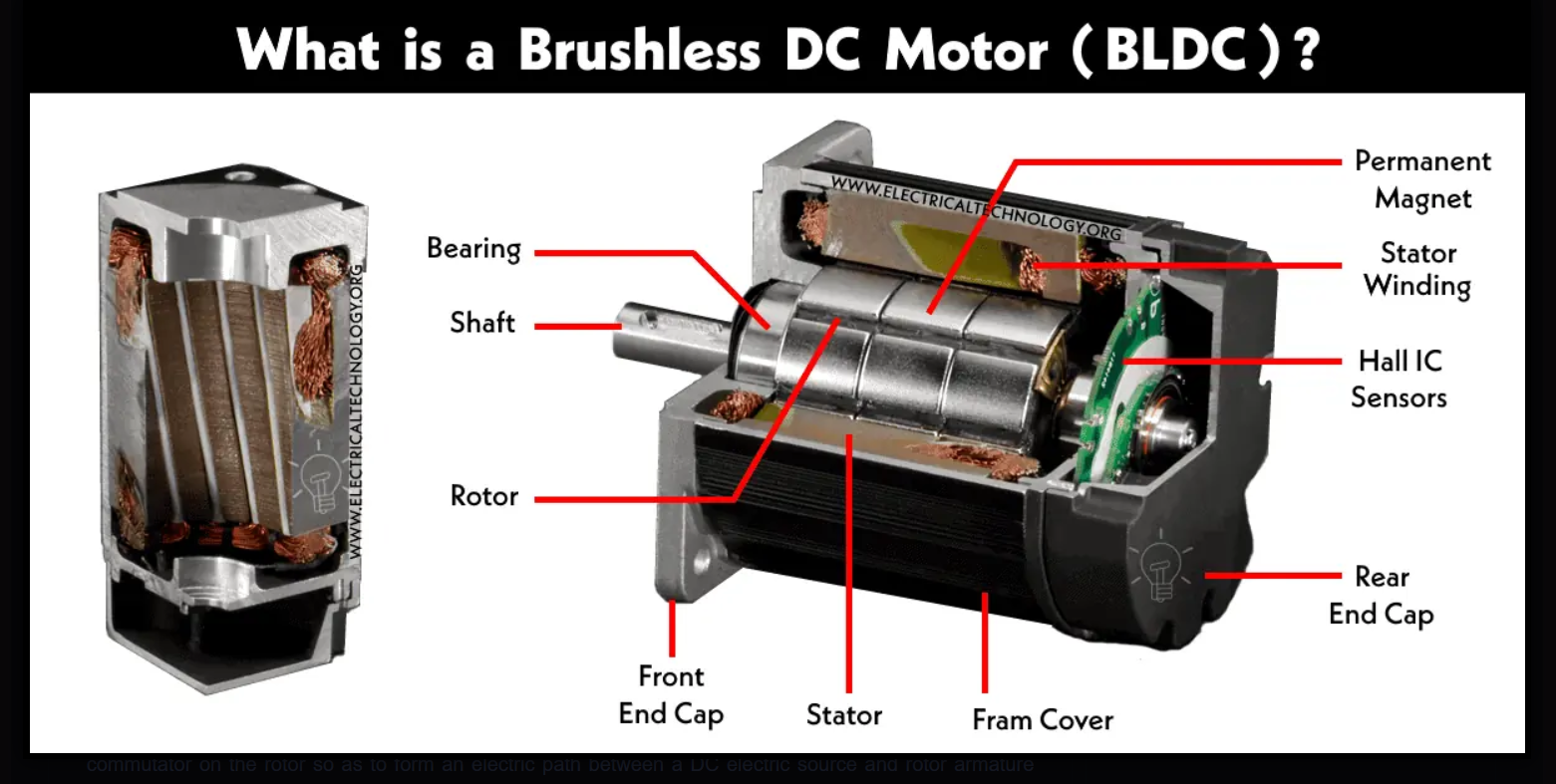
What is a BLDC Motor
A Brushless DC (BLDC) Motor is an electric motor that achieves mechanical commutation electronically rather than mechanically. Unlike traditional brushed DC motors, which use physical brushes and a commutator to switch current between windings, a BLDC motor relies on electronic control circuitry to determine which winding should be energized at any given instant.
Physically, a BLDC motor consists of a permanent magnet rotor and a stator containing multiple windings. The absence of brushes eliminates frictional losses, reduces maintenance requirements, and significantly improves reliability. This makes BLDC motors one of the most widely used motor technologies in modern embedded and industrial systems.
At first glance, the name can be somewhat misleading. Although it is called a “Brushless DC” motor, the motor itself is typically driven using a three-phase AC waveform generated from a DC power source. The “DC” in the name refers to the power source rather than the electrical waveform present in the motor windings.
What was the Need for It
Traditional brushed DC motors were revolutionary because they provided simple speed control and excellent low-speed torque. However, they came with a fundamental problem: brushes.
The brushes continuously rub against the commutator during operation. Over time, this causes mechanical wear, electrical arcing, heat generation, electromagnetic interference, and efficiency losses. In applications requiring long operating life or high rotational speeds, the brushes become a major reliability bottleneck.
As power electronics became cheaper and microcontrollers became more capable, engineers realized that the mechanical commutator could be replaced entirely with software and switching circuitry. Instead of physically changing which winding receives current, a controller could perform the same operation electronically.
The result was the BLDC motor: a motor capable of higher efficiency, greater reliability, lower maintenance, reduced acoustic noise, and significantly longer operational life. These advantages made BLDC motors particularly attractive for industrial automation, robotics, electric vehicles, drones, and consumer electronics.
How Does It Work
The fundamental principle behind a BLDC motor is surprisingly simple: a magnetic field is generated in the stator, and the permanent magnets on the rotor continuously attempt to align themselves with that field.
Imagine three stator windings (coils) arranged around the motor. By energizing these coils in a specific sequence, a rotating magnetic field is created. The coils are switched electronically by transistors or silicon controlled rectifiers at the correct rotor position in such a way that armature field is in space quadrature with the rotor field poles. Hence the force acting on the rotor causes it to rotate.
The challenge is knowing exactly when to switch from one winding combination to the next. This process is known as commutation. To achieve this, the controller must continuously estimate or measure the rotor position. In sensored systems, Hall-effect sensors provide rotor position feedback. In sensorless systems, the controller observes electrical characteristics such as back-EMF to determine rotor position.
As the rotor moves, the controller energizes different winding combinations, effectively pulling the rotor around in a continuous cycle. The faster the controller rotates the magnetic field, the faster the motor spins. 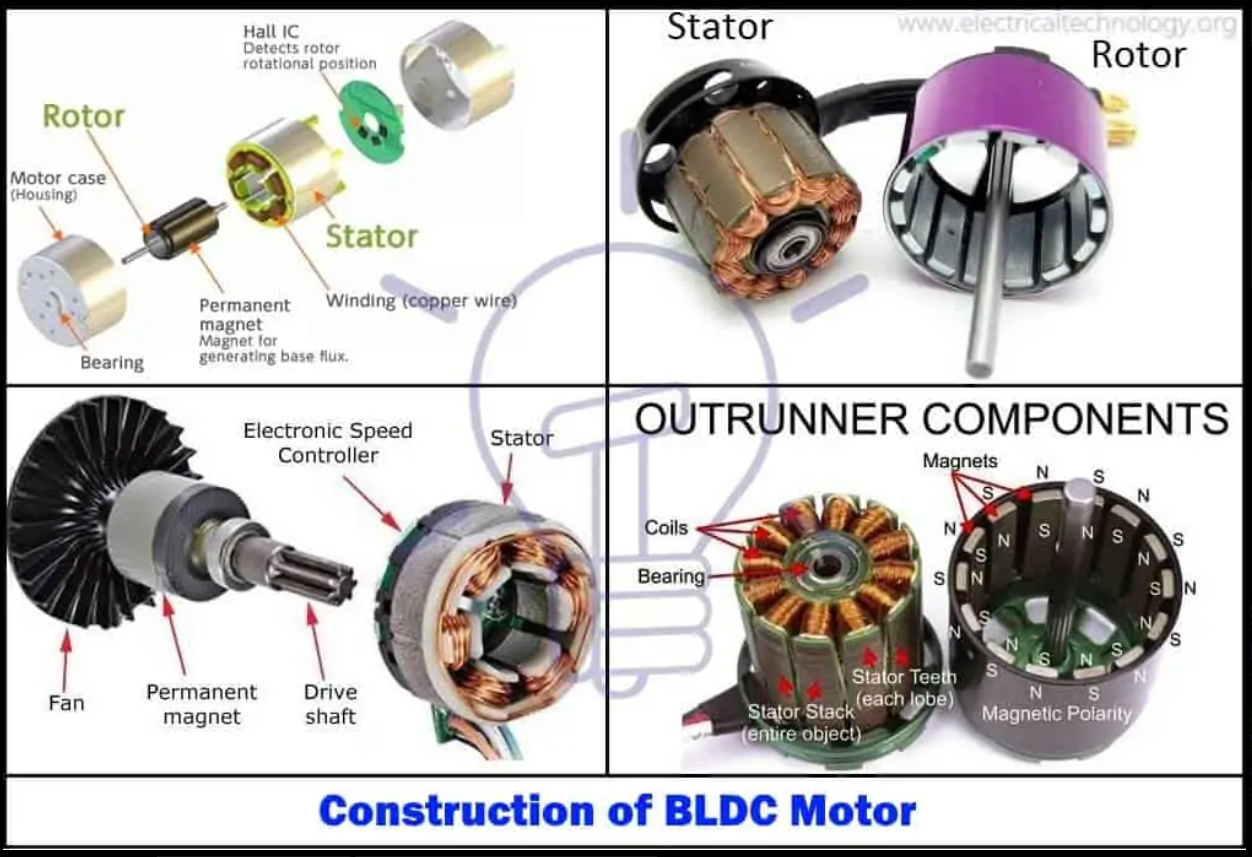
How is it Driven
A BLDC motor cannot simply be connected directly to a DC supply and expected to simply start spinning. It requires an electronic drive circuit, commonly called an Electronic Speed Controller (ESC).
The ESC performs two major functions:
- Converts DC power into three-phase drive signals.
- Determines the correct commutation sequence based on rotor position.
Most BLDC drives use a three-phase inverter consisting of six MOSFETs arranged in a bridge configuration. By selectively turning these MOSFETs on and off, the controller generates the required phase voltages for the motor.
Modern motor controllers often employ techniques such as:
• Six-step (trapezoidal) commutation
• Sinusoidal commutation
• Field Oriented Control (FOC)
Six-step commutation is simple and inexpensive but can produce torque ripple and audible noise. Sinusoidal commutation improves smoothness, while FOC provides the highest efficiency, best torque control, and near-silent operation. FOC is commonly used in electric vehicles, robotics, and high-performance industrial drives.
The entire process is typically managed by a microcontroller or dedicated motor-control processor that continuously reads rotor position feedback and updates the inverter switching pattern in real time.
What are the Uses
BLDC motors have become nearly ubiquitous because they offer an excellent balance between efficiency, power density, reliability, and controllability.
Common applications include:
• Electric vehicles and e-bikes – These motors offer far greater electrical reliability and mechanical durability than their brushed counterparts. Their high efficiency, excellent torque characteristics, and low maintenance requirements make them ideal for traction applications where long operating life and energy efficiency are critical.
• Industrial automation systems – Modern factories depend heavily on precise motion control. BLDC motors can provide accurate speed and position control while operating continuously for thousands of hours, making them well-suited for conveyor systems, CNC machines, automated assembly lines, and packaging equipment.
• Robotic actuators and joints – FOC algorithms, combined with high-performance motor drivers and feedback sensors, allow BLDC motors to deliver precise torque and position control. This makes them suitable for applications ranging from large industrial manipulators to compact collaborative robot (CoBot) joints.
• Computer cooling fans – Nearly every modern PC fan uses a small BLDC motor. The absence of brushes reduces acoustic noise and increases lifespan, while electronic speed control allows the system to dynamically adjust airflow based on thermal requirements.
• Hard disk drives – Hard drives require the platters to spin at extremely precise rotational speeds, often between 5,400 and 15,000 RPM. BLDC motors provide the smooth operation, low vibration, and reliability necessary to maintain data integrity over years of continuous operation.
• Drones and quadcopters – High power density and rapid response times make BLDC motors the preferred choice for aerial vehicles. Flight controllers continuously adjust motor speeds hundreds of times per second to maintain stability, altitude, and maneuverability.
• Power tools – Cordless drills, grinders, saws, and impact drivers increasingly use BLDC motors because they offer greater efficiency, higher torque output, reduced heat generation, and longer battery life compared to traditional brushed motors.
• HVAC systems – Heating, ventilation, and air-conditioning systems often run continuously for extended periods. BLDC motors help reduce energy consumption while providing variable-speed operation, allowing airflow and compressor performance to be adjusted according to demand.
• Washing machines – Modern washing machines use BLDC motors to precisely control drum speed during wash, rinse, and spin cycles. Their ability to deliver high torque at low speeds improves washing performance while reducing noise and power consumption.
• Electric pumps and compressors – Many pumps and compressors operate under varying load conditions. BLDC motors enable variable-speed operation, allowing the system to deliver only the required output while improving efficiency and reducing mechanical wear.
This section also subtly highlights a recurring theme: BLDC motors are not popular because they spin things; they’re popular because software can precisely control how they spin things. That’s arguably their biggest advantage over traditional motor technologies.
Some Example Pieces
A BLDC motor system is rarely just the motor itself. A complete implementation typically consists of multiple components working together.
Motor
- Rotor with permanent magnets
- Three-phase stator windings
Power Stage
- Three-phase inverter
- High-side and low-side MOSFETs
- Gate driver ICs
Position Feedback
- Hall-effect sensors
- Magnetic encoders
- Resolver interfaces
- Sensorless back-EMF measurement circuitry
Controller
- STM32 motor-control MCUs
- TI C2000 controllers
- NXP motor-control processors
- Dedicated ESC firmware
Protection Circuits
- Overcurrent protection
- Overvoltage protection
- Thermal monitoring
- Stall detection
If you’ve ever flown a drone, ridden an electric scooter, used a cordless drill, or even listened to a laptop fan spin up during a heavy workload, you’ve almost certainly interacted with a BLDC motor. Modern electronics would be difficult to imagine without them.
## Sources
STMicroelectronics Motor Control Resources
https://www.st.com/en/motor-control.htmlST Motor Control Software Development Kit (MCSDK)
https://www.st.com/en/embedded-software/x-cube-mcsdk.htmlTexas Instruments Motor Drivers and Motor Control Resources
https://www.ti.com/motor-drivers/overview.htmlTexas Instruments C2000 Motor Control SDK
https://www.ti.com/tool/C2000WARE-MOTORCONTROL-SDK- Infineon Motor Control and Drives
https://www.infineon.com/cms/en/applications/industrial/motor-control-and-drives/ - NXP Motor Control and Drives
https://www.nxp.com/applications/industrial/motor-control-and-drives:MC_DRIVES R. Krishnan, Permanent Magnet Synchronous and Brushless DC Motor Drives
https://www.routledge.com/Permanent-Magnet-Synchronous-and-Brushless-DC-Motor-Drives/Krishnan/p/book/9780824753849Austin Hughes, Electric Motors and Drives: Fundamentals, Types and Applications
https://www.elsevier.com/books/electric-motors-and-drives/hughes/978-0-08-102615-1Microchip Application Notes on BLDC Motor Control
https://www.microchip.com/en-us/solutions/technologies/motor-control-and-drive- Analog Devices Motor Control Solutions
https://www.analog.com/en/applications/technology/motor-and-motion-control.html
Leave a Comment